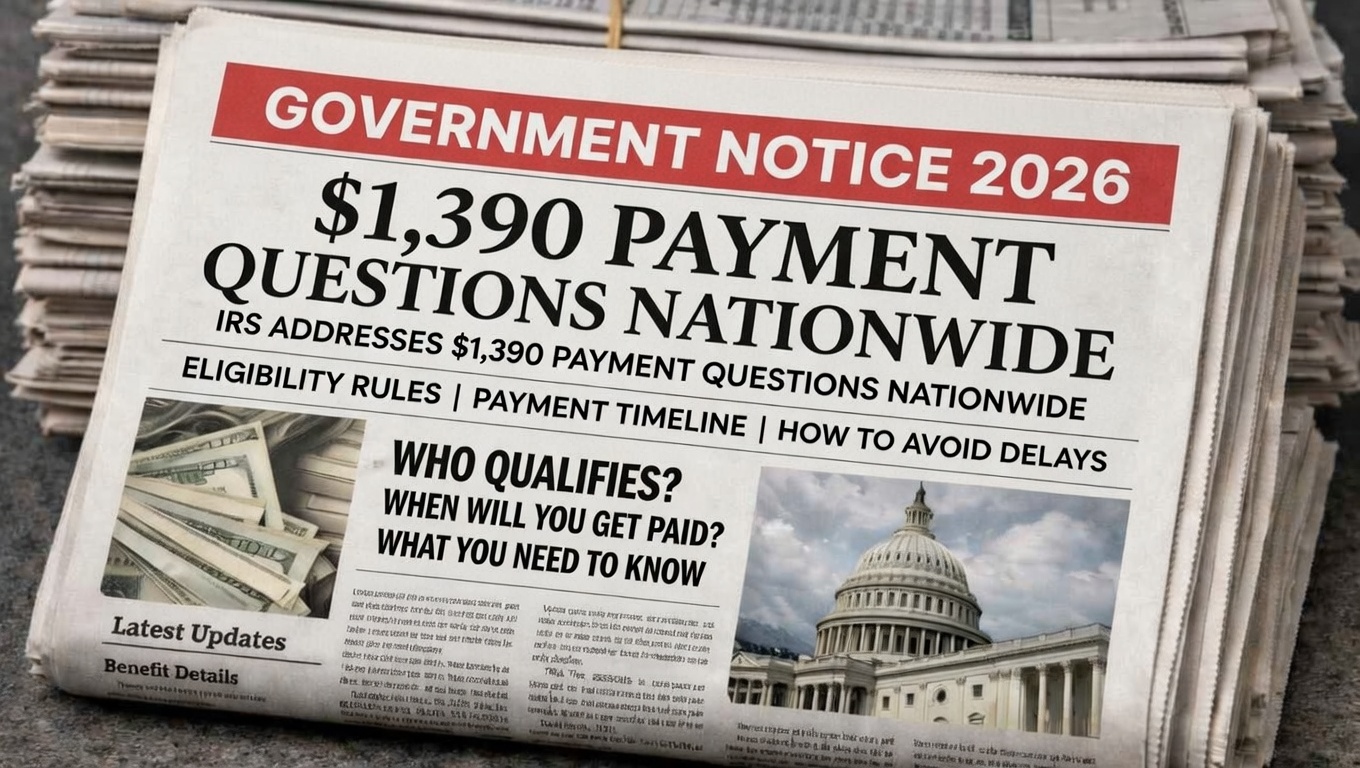
Government Notice 2026: In 2026, a specific dollar figure began spreading rapidly across social media platforms, online forums, and digital communities, capturing the attention of millions of Americans who were already closely watching for news about government payments amid ongoing economic uncertainty. The number in question was $1,390, and within a short period it had generated significant buzz with many people believing it represented a new and broadly available government payout similar to the stimulus checks distributed during previous periods of economic hardship. However, official clarification from tax authorities quickly established that this figure is not a blanket relief payment or a new government benefit program available to all Americans. Instead, the amount reflects individual tax adjustments that arise from specific filing situations unique to particular taxpayers rather than any universally applied policy or legislative decision.
Where the $1,390 Figure Actually Came From
Understanding the origin of this widely discussed figure is essential for any taxpayer trying to make sense of the claims circulating across digital platforms. The number did not emerge from any formal government program announcement, press conference, or legislative action that would typically accompany the launch of a new national benefit. Rather, it appears to have first surfaced when individual taxpayers who received refunds in that particular amount began sharing screenshots of their payments online, and those images were then interpreted by many viewers as evidence of a new nationwide payment scheme. Tax analysts who track misinformation trends in the financial space note that specific and precise dollar figures carry an air of credibility that makes them particularly prone to viral spread, as people tend to find exact numbers more convincing and official-sounding than general claims. In reality, refund totals vary enormously from one taxpayer to the next, and a single dollar amount rarely applies universally across the entire taxpaying population.
What the Payment Actually Represents
According to official clarifications from tax authorities, the $1,390 figure that some taxpayers have received in their accounts stems from routine tax administration processes rather than any new program or policy. Specifically, such amounts may result from the reconciliation of refundable credits, corrections to discrepancies in prior filings, or adjustments related to differences between the amount of tax withheld throughout the year and the taxpayer’s actual final liability. The tax system processes every individual return separately, comparing reported income against claimed credits and payments already made throughout the year, and when the calculations show that the government owes money to a filer, the result is issued as a refund. The fact that some of these individually calculated refunds happen to equal $1,390 is a coincidence of arithmetic rather than evidence of a coordinated distribution program, and taxpayers who received this amount simply had filing circumstances that produced that particular outcome.

Who Might Receive This Amount and Who Will Not
Eligibility for any specific refund amount is determined by a combination of factors that are entirely unique to each individual taxpayer’s financial situation and cannot be predicted or guaranteed based on viral social media claims. Adjusted gross income, filing status, number of qualifying dependents, and any advance credits previously received all play significant roles in determining whether a taxpayer receives a refund and how large that refund will be. Taxpayers who qualified for refundable tax credits or whose withholdings throughout the year exceeded their actual tax liability are the most likely candidates to receive refunds, while those whose tax situations were straightforward and balanced may see little or no additional funds. Experts are emphatic on one critical point which is that there is no application process for a special $1,390 payment because no such program exists, and anyone who qualifies for a refund will receive it automatically once their return has been fully processed through normal channels.
How This Differs From Previous Stimulus Payments
Part of the public confusion surrounding this situation stems from the understandable memory of pandemic-era stimulus distributions when fixed payment amounts were formally announced, legislatively authorized, and broadly distributed to eligible Americans based on clearly defined income thresholds. Those programs followed a very specific and highly publicized process involving congressional approval, formal budget allocation, weeks of mainstream media coverage, and official eligibility calculators that allowed people to determine in advance what they would receive. The current situation is fundamentally different in every important respect because there has been no new stimulus legislation passed, no congressional action authorizing a standard payout, and no formal government announcement describing a new relief program. Policy experts point out that the absence of any legislative activity or major media coverage surrounding an alleged new payment is itself a powerful indicator that no such program exists and that the viral figure reflects nothing more than routine tax filing outcomes.
Protecting Yourself From Financial Misinformation
Financial advisors and tax professionals consistently recommend that taxpayers resist the temptation to make budgeting or spending decisions based on viral payment claims that have not been confirmed through official government sources. Reviewing your official tax transcript or refund summary directly through the IRS website provides the clearest and most accurate picture of how your specific refund was calculated and whether any adjustments were applied to your account. Keeping your banking information and personal details current with the IRS helps ensure that any funds legitimately owed to you arrive promptly through direct deposit without unnecessary delays. Most importantly, verifying financial information exclusively through official government channels rather than social media posts or unverified online forums is the single most effective habit any taxpayer can develop to protect themselves from the ongoing cycle of viral payment rumors that appears each tax season.

Disclaimer: This article has been written purely for informational and general awareness purposes based on publicly available tax guidance and official agency statements regarding the circulating claims about an IRS $1,390 payment in 2026. Payment eligibility, refund amounts, processing timelines, and tax credit qualifications vary significantly according to individual tax filing circumstances, income levels, and current IRS verification procedures which are subject to change. Nothing in this article constitutes legal, tax, financial, or professional advice of any kind. Readers are strongly encouraged to consult the official IRS website at irs.gov or seek guidance from a certified tax professional for accurate and personalized information specific to their own financial situation. The author and publisher shall not be held responsible for any decisions made based on the content provided in this article.